

 Vasai, Maharashtra
An outboard can stop for a dozen reasons: water in the fuel, a fouled propeller, a flat starter battery. A pair of oars gets the boat to the shore, holds its head to the waves while the crew works on the engine, or moves it the last few metres to a jetty in water too shallow to run the motor.
Why should a small boat carry oars?
Because they need no fuel, no battery and no spare parts. A dinghy, a rescue boat or a small fishing craft with oars aboard can always move. They are also the quiet way to come into a crowded landing, to hold position over a net, or to move a boat in a flooded street where a propeller would catch on debris.
Leaf blade or narrow blade: which is better?
Neither is better for every boat: it depends on the boat and the rower. A wide blade holds more water on each stroke, so it pushes harder; it also takes more effort to pull, and suits short bursts and heavier boats. A narrower blade slips a little more but is lighter to pull for a long time, and suits a steady pace over a distance.
MM’s two plastic oars sit either side of that line. The MMPO-01 has a leaf blade, L 400 × W 230 mm. The MMPO-02 has a narrower blade, L 370 × W 150 mm. Both are telescopic: 4.7 ft closed and 7.8 ft extended, with a T-type handle or without a handle.
| Model | Closed length | Extended length | Blade |
|---|---|---|---|
| MMPO-02 | 4.7 ft | 7.8 ft | L 370 × W 150 mm |
| MMPO-01 | 4.7 ft | 7.8 ft | L 400 × W 230 mm |
How long should an oar be?
A common rule of thumb puts an oar at about twice the width between the rowlocks; too short and the blade barely reaches the water, too long and the handles cross. A telescopic oar lets one pair suit more than one boat: extended for a wider hull, closed for a narrow one, and closed again for stowage.
What does a rowlock do?
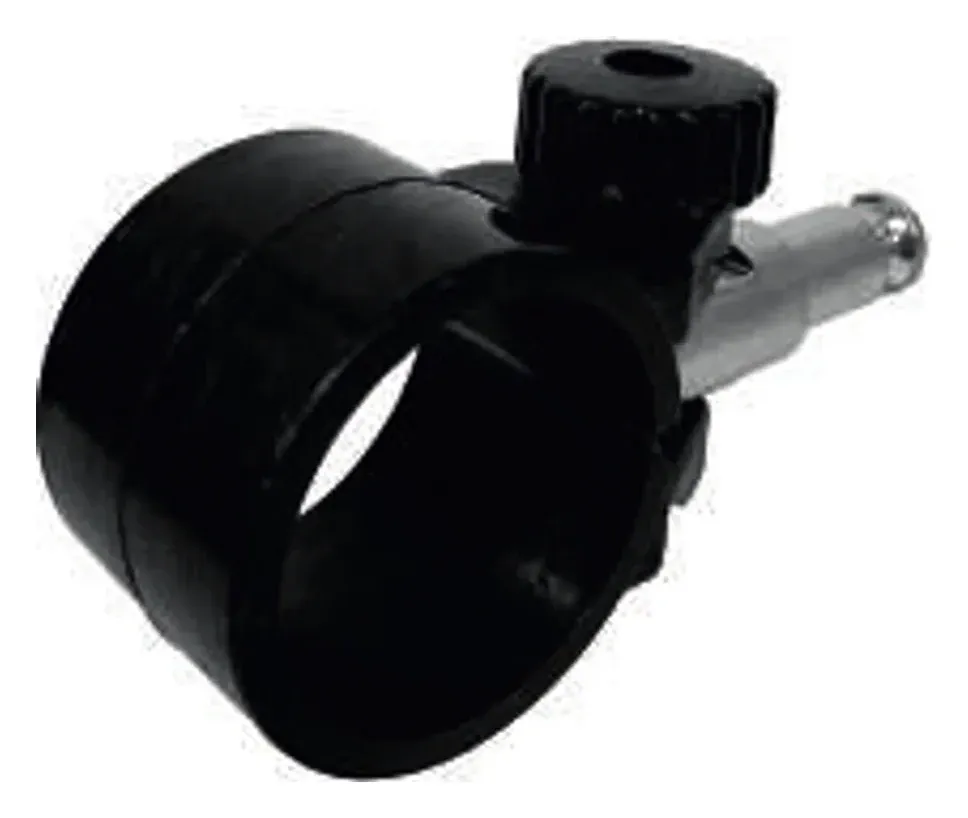
A rowlock, or oarlock, is the pivot: it holds the oar to the gunwale and turns the rower’s pull into a push on the water. Without one the oar slides and the stroke is lost. The MMORL secures the oar to the boat. It is reinforced black synthetic plastic, rustproof, rattle-free and squeak-free.
What is a boat hook for?
A boat hook is a pole with a hook at the end, for reaching what an arm cannot: picking up a mooring line or a buoy, holding the boat to a jetty, fending off, and recovering a line or a lifebuoy from the water. It should never be used to hook a person; pass them the pole, or a line, to hold.
The MMTBH telescopic boat hook is an anodised aluminium tube with a plastic hook and a plastic locking ring, extending 24″ to 48″, or 48″ to 96″. The plastic hook on its own, the MMPBH, fits a pole of 30 mm diameter, for crews who use their own poles.
How should oars and a boat hook be stowed?
- Close the telescopic sections and lash the oars under the thwarts or along the side, where they cannot go over the side in a sea and can be freed quickly.
- Keep the rowlocks with the oars, tied to the boat by a short lanyard: a rowlock dropped overboard ends the rowing.
- Rinse the aluminium tubes with fresh water after use in salt water, and check the locking rings still hold.
- Keep the blades out of the sun when the boat is laid up.
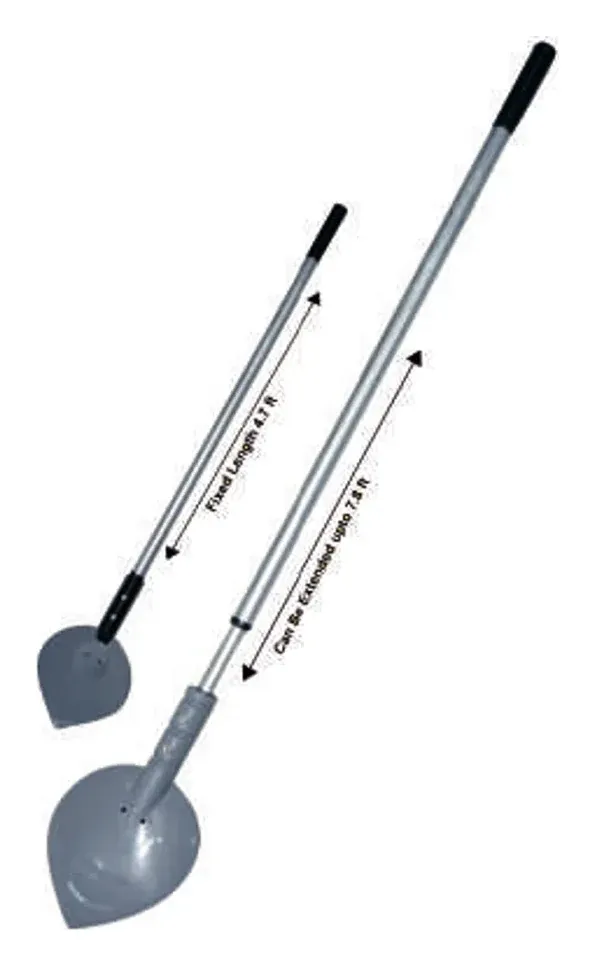
Plastic Leaf Oar – MMPO-01
Model MMPO-01
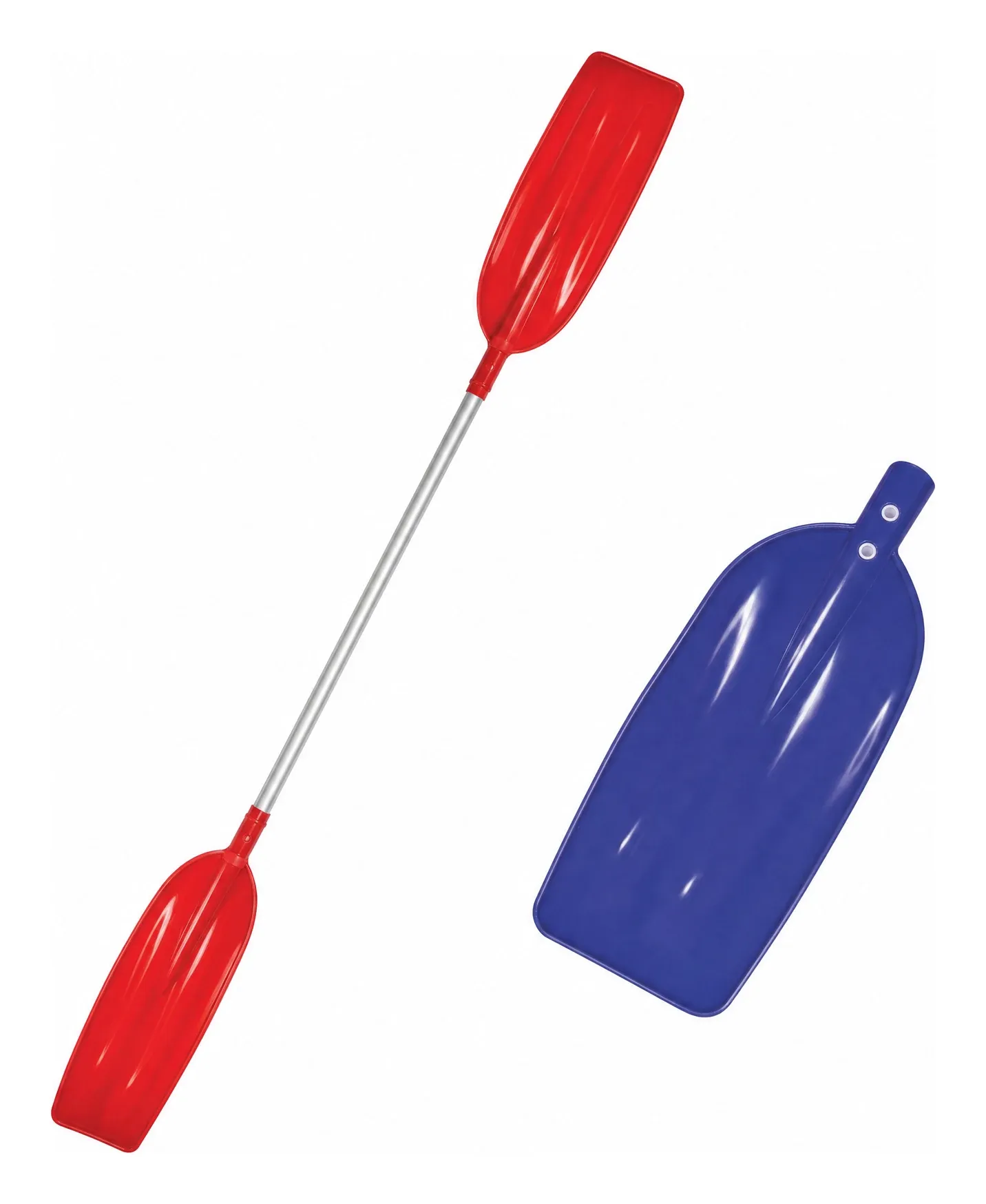
Plastic Blade Oar – MMPO-02
Model MMPO-02
Plastic Oar Row Lock – MMORL
Model MMORL
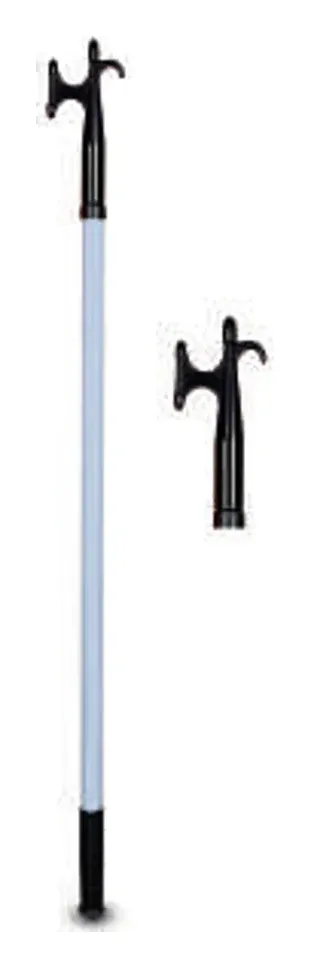
Telescopic Boat Hook – MMTBH / MMPBH
Model MMTBH / MMPBH
Oars belong on the fishing boat safety checklist with the rest of the kit. Request a quote naming the oar, the handle type, the boat hook length and the number of rowlocks.