

 Vasai, Maharashtra
A gill net can stretch a long way from the boat that set it, with only a few floats showing at the surface. At night those floats are invisible. A flashing light on the net end, or on the marker buoy, lets the crew find their gear again and lets other boats see it before they run over it.
Why are fishing nets marked with lights?
So the net can be found and avoided in the dark. The reasons in full:
- To find the net again. A drifting or set net moves with the tide; a light on its end shows where it went.
- To keep other boats off it. A propeller through a net costs the net, and can disable the boat that hit it.
- To show who it belongs to and where it ends, when several boats work the same ground.
- To reduce lost gear: a net that cannot be found keeps fishing on its own.
What do the COLREGs say about fishing gear?
Rule 26 of the COLREGs sets the lights a vessel engaged in fishing shows: green over white for a trawler, red over white for other fishing vessels, with sidelights and a sternlight when making way. A vessel fishing other than by trawling, with outlying gear extending more than 150 m horizontally, also shows an all-round white light, or by day a cone apex upwards, in the direction of the gear.
Those are the vessel’s lights. The COLREGs do not set lights for the net itself. How the gear is marked, including any lights, flags or colours on the end buoys, is set by national and state fisheries rules, and the FAO’s Voluntary Guidelines on the Marking of Fishing Gear, endorsed in 2018, give a global reference. Check what your state’s fisheries department requires before choosing colours. The navigation lights guide covers the boat’s own lights.
What is the Scorpio flashing light?
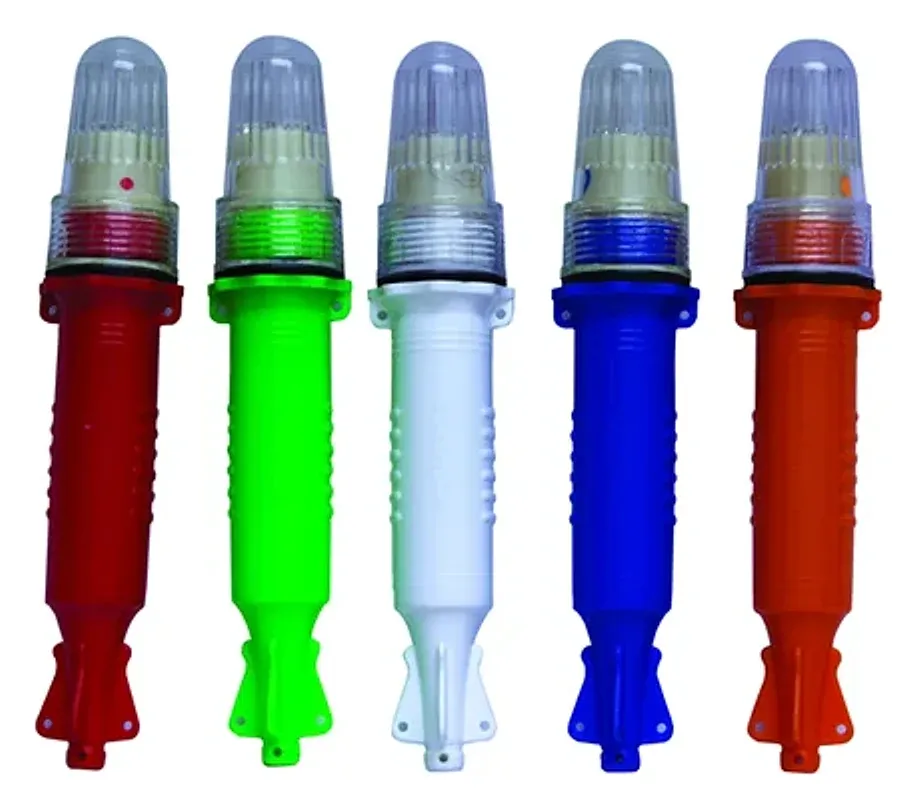
The Scorpio is an LED flashing light for marking fishing nets at night, in single-flashing and double-flashing versions. The LED works with a capacitor designed to save energy. It runs on 2 × D cells, at 1–3 V and 70 mA, and its working time is 2160 h.
| Specification | Value |
|---|---|
| Voltage | 1–3 V |
| Current | 70 mA |
| Working time | 2160 h |
| Battery | 2 × D cells |
| Colours | White, warm white, red, blue, green, magenta |
Which colour should you choose?
The Scorpio comes in white, warm white, red, blue, green and magenta. Three things decide the choice:
- Local rules or practice, where the fisheries department or the harbour sets colours for net ends.
- Telling ends apart: one colour for the end nearer the boat and another for the far end, or a colour for each boat working the same ground.
- Avoiding confusion with navigation lights and buoyage: a steady red or green near a channel can be mistaken for a mark. A flashing light helps, and so does choosing colours with the harbour in mind.
Fit the light on the end buoy or the dhan pole, not low on the net itself, so it stands clear of the water and can be seen from any side. A light that lies flat in the swell shows only now and then. Tie it on with a line strong enough to survive the net being hauled, and fit it so it can be taken off for a cell change without cutting the lashing.
How do you look after a net light?
- Fit fresh D cells at the start of the season, both cells new and of the same type.
- Check the seal between the dome and the body each time the cells are changed; a light that floods stops.
- Rinse it in fresh water after a trip and dry it before storing.
- Take the cells out when the light is laid up through the monsoon fishing ban.
- Switch every light on before the boat leaves, not when the net is going over.
Scorpio Flashing Light (Single / Double Colour)
Commercial Fishing
Floats for the same net are in choosing fishnet floats. Request a quote with the version, the colours and the number of each.