


 Vasai, Maharashtra
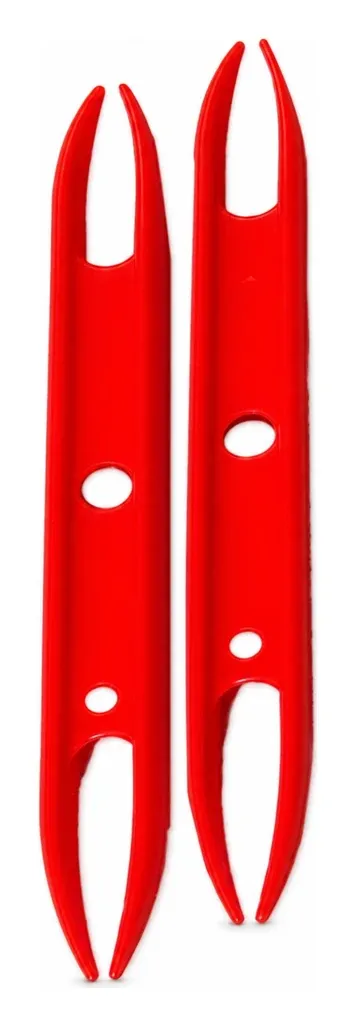
Every net tears. A snag on a rock, a big fish, a propeller or a dolphin will open a hole, and an open hole lets the catch out. Mending it on the boat or on the quay keeps the net fishing, and the one tool it needs is a net mending needle.
What is a net mending needle?
A net mending needle, also called a tasri, is a flat shuttle that carries the twine. It has a fork at one end and a tongue in an open slot near the other. Twine is wound on around the tongue and through the fork, so the loaded needle passes through a mesh and lets out twine as each knot is tied. MM’s net mending needles come in 5″, 6″, 7″ and 10″.
| Specification | Value |
|---|---|
| Sizes | 5″, 6″, 7″ and 10″ |
Which needle size do you need?
The loaded needle must pass easily through the mesh being mended. A needle too wide for the mesh will not go through; one much smaller than it holds little twine and has to be reloaded often. As a rule: small needles for small-mesh nets and fine twine, such as gill nets for small fish; larger needles for bigger mesh and thicker twine, such as purse seines and trawls. A crew that works more than one net carries more than one size.
Most menders also use a gauge, or mesh stick: a flat stick that the twine is pulled round as each knot is tied, so every new mesh comes out the same size as the old ones. The needle must be narrower than the gauge.
How is a torn mesh mended?
The steps below are the common method. Practise on a scrap of old net first.
- Load the needle with twine of the same material and thickness as the net.
- Spread the net so the hole lies flat, with the meshes hanging the way they hang in use.
- Trim the hole. Cut away broken twine and loose ends so that the hole has a starting knot at the top with three bars still attached and one cut away, a finishing knot of the same kind at the bottom, and every other knot round the edge with two bars.
- Tie the twine to the starting knot.
- Work across the hole row by row, forming each new mesh over the gauge and tying it to the next open knot with a sheet bend, the netting knot.
- At the end of each row, tie on at the side of the hole and turn back for the next row.
- Close the last row onto the finishing knot and tie off firmly.
- Check every new mesh is the same size as its neighbours, and that no knot will slip.
What are the common mistakes?
- Not trimming first: a hole with ragged ends cannot be closed neatly, and leaves weak points.
- Meshes pulled too tight or left too slack: an uneven patch changes how the net hangs, and the wrong mesh size can let undersized fish through or catch them.
- Wrong twine: thicker or stiffer twine than the net makes a hard patch that wears the meshes around it.
- Knots tied loosely: a sheet bend in nylon must be pulled hard so it does not slip under load.
How should needles be looked after?
Keep a loaded needle of each size in the mending kit so a hole can be closed when it is found. Rinse salt off and keep needles out of strong sun when they are not in use. A cracked tongue or a broken fork catches the twine; replace that needle.
Net Mending Needles
Commercial Fishing
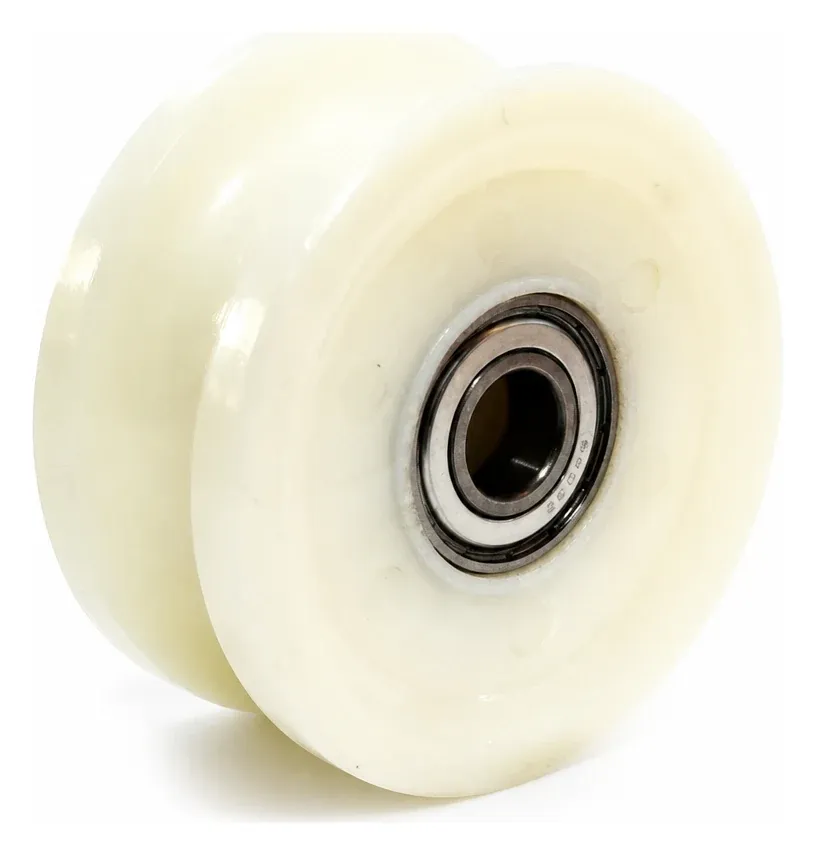
Nylon Pulley / P. P. Pulley
Commercial Fishing
How the nets themselves work is in purse seine, gill net and trawl. Request a quote with the sizes and the quantity of each.