


 Vasai, Maharashtra

A handline is the oldest way to fish: a line, a weight and a hook, held in the hand. A hand caster adds one thing, a spool to wind the line on and throw it from. It has no gears, no handle and nothing to rust or jam.
What is a hand caster?
A hand caster is a hand-line fishing reel: a ring-shaped spool with a groove round its outside and a raised rim on each side. The line is wound into the groove. Held face-on to the water, the line slips off over the rim when the rig is thrown; turned side-on, it is wound back on by hand. It is used from boats, jetties, rocks and beaches.
How do you wind the line on?
- Tie the line to the spool with a knot that will not slip round the groove.
- Wind it on in even turns, under light tension, keeping the line spread across the groove rather than piled in one place.
- Leave a little of the groove empty below the rim, so the line does not spill off on its own.
- Tie on the weight and hook, with a swivel between line and trace if the bait spins.
How do you cast and retrieve?
- Hold the caster in one hand with its face pointing where you want the rig to go, and trap the line against the rim with a finger.
- Swing the weight and hook with the other hand, a short length of line hanging below, and let it go towards the target while lifting the trapping finger.
- The line spirals off over the rim. Stop it with the finger when the rig lands, or let it run to the bottom.
- Feel for bites through the line in your fingers; a handline gives a direct feel that a rod softens.
- To bring the line back, turn the caster side-on and wind the line onto it with the other hand, or haul hand over hand onto the deck and wind on later.
Practise the cast on land first, with a weight and no hook. Most tangles come from line wound on loosely or a finger lifted too late, and both are easy to fix once the rhythm is learned.
From a boat over deep water there is often no casting at all: the line is let down over the side and wound back, and the caster is a spool that stores the line without tangling.
Which size do you need?
A larger caster holds more line and brings in more line with each turn of the hand. A smaller one is lighter, fits a pocket and suits light line from a jetty. Pick by the depth of water and the thickness of the line: deep water and heavy line want the larger sizes. MM’s hand casters come in two series and seven sizes: the M series from the M105 small to the M109 jumbo, and the # series, #107, #108 and #109.
| Specification | Value |
|---|---|
| M series | M105 small, 126 × 52 mm; M107 medium, 158 × 52 mm; M108 big, 190 × 54 mm; M109 jumbo, 230 × 66 mm |
| # series | #107, 170 × 36 mm; #108, 200 × 46 mm; #109, 225 × 50 mm |
How do you look after the line?
- Rinse the caster and line in fresh water after fishing in salt water, and let them dry before storing.
- Run the end of the line through your fingers before each trip; cut off any length that is nicked, flattened or rough.
- Keep the caster out of strong sun: sunlight weakens nylon line over time.
- Replace line that has gone stiff, cloudy or brittle.
- Wind on under tension after every trip, so loose turns do not bed in and tangle on the next cast.
Hand Caster (Fishing Reel)
Commercial Fishing
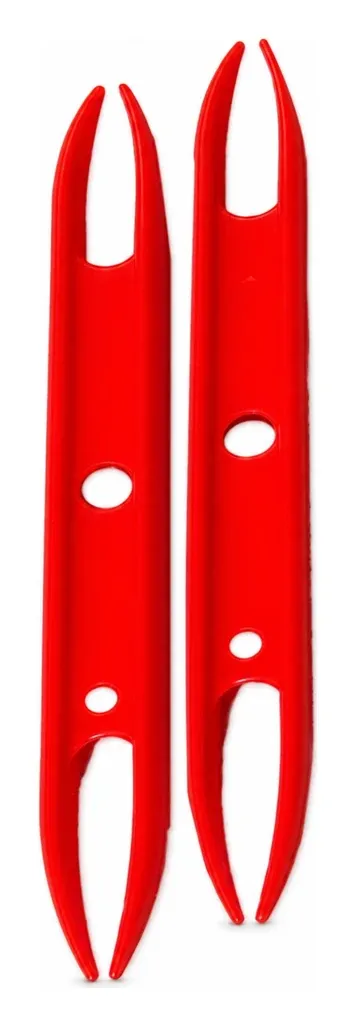
Net Mending Needles
Commercial Fishing
The rest of the small fishing hardware is in net mending needles, pulleys and hand casters. Request a quote with the series, the sizes and the quantity of each.